
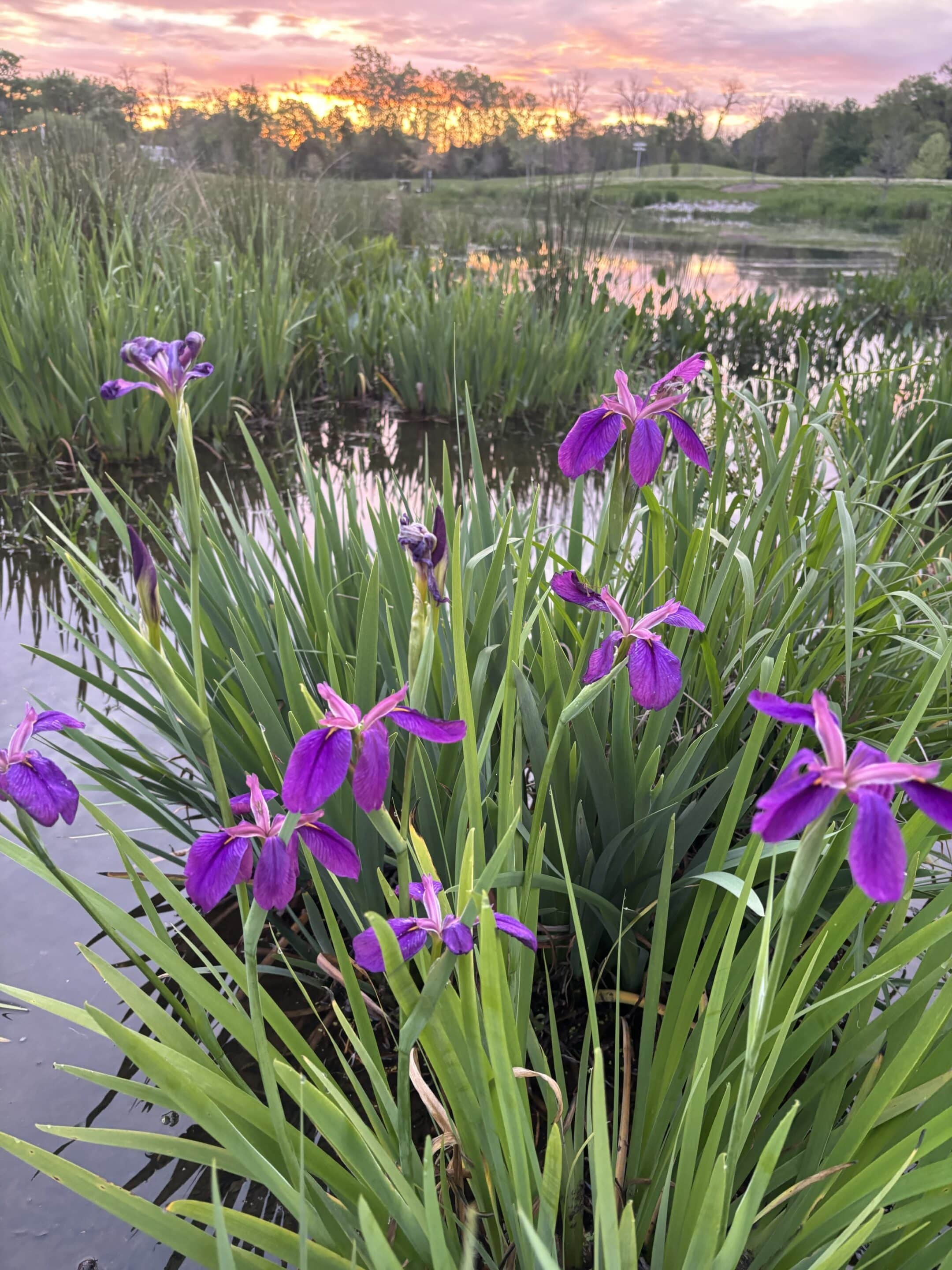
Discover Louisiana Irises at Moncus Park
Each spring, Louisiana irises transform parts of Moncus Park into vibrant displays of color. These remarkable flowers are native to the wetlands of the southeastern United States and thrive in Louisiana’s warm, water-rich landscape.
Throughout the park, visitors can explore interpretive signs that share the story of Louisiana irises — from their native species and fascinating history to the people who helped preserve and cultivate them. Together, these signs reveal the rich natural and cultural legacy behind one of Louisiana’s most beloved native flowers.
Louisiana Irises: A Flower of the Wetlands
Louisiana irises are wetland plants recognized by their bright green, fan-shaped leaves and large, colorful blooms that appear from March through early May.
In nature, they grow along bayous, swamps, marsh edges, and other damp environments where soils remain moist or flooded. Because they thrive in wet conditions, they are an important part of wetland ecosystems.
Today, these native species and their hybrids are also cultivated in gardens for their remarkable beauty and wide range of colors including blue, purple, red, yellow, pink, gold, burgundy, and white.
The nectar-rich flowers attract hummingbirds, butterflies, bees, and other pollinators, helping support biodiversity in wetland habitats.
Did you know?
The Louisiana iris is the official state wildflower of Louisiana.
The Five Native Louisiana Iris Species
Louisiana irises are part of a small but remarkable group of iris species. While there are nearly 300 iris species across the Northern Hemisphere, only a handful belong to the Louisiana iris group.
Five closely related species form the foundation of Louisiana irises, often referred to as “The Louisianans.”
-
Iris brevicaulis — Zigzag Iris
-
Iris fulva — Copper Iris
-
Iris giganticaerulea — Giant Blue Iris
-
Iris hexagona — Dixie Iris
-
Iris nelsonii — Abbeville Red Iris
Only in south Louisiana do all five of these species occur together in the wild.
Because these species are naturally cross-fertile, they can hybridize with one another. This ability has allowed gardeners and breeders to develop the extraordinary range of Louisiana iris cultivars seen in gardens today.
A History of Louisiana Irises
1788–1817
Early Recognition
Several Louisiana iris species were first described by botanists in the late 1700s and early 1800s. Despite their striking appearance, these discoveries attracted little attention at the time, and the plants remained largely unknown outside their native wetlands.
1909–1925
Modern Discovery
By the early 1900s, Louisiana irises had been scientifically described but were still rarely cultivated. Gardeners and naturalists such as Mary Hutson Nelson, Caroline Dormon, Percy Viosca, and Mary Swords Debaillon began collecting the plants and introducing them into gardens.
By the mid-1920s, an informal network of Louisiana iris enthusiasts had formed across the state.
1925–1938
Dr. John Kunkel Small Sparks Interest
In 1925, botanist Dr. John Kunkel Small, Head Curator of the New York Botanical Garden, began studying Louisiana irises after encountering vast fields of them near New Orleans.
Fascinated by their diversity, he returned repeatedly to explore the wetlands of south Louisiana, collecting plants and seeds for study. Small transported thousands of irises to the New York Botanical Garden, where he documented their remarkable variation in color, size, and form.
His research brought national attention to Louisiana irises and helped inspire a new generation of collectors, botanists, and gardeners.
1926–Early 1940s
The Era of Collecting
Inspired by these discoveries, plant enthusiasts began traveling into Louisiana’s swamps and wetlands searching for new iris forms.
This period revealed the incredible diversity of Louisiana irises and laid the foundation for modern hybrid breeding.
1938
Discovery of the Abbeville Red Iris
Near Abbeville, Louisiana, a striking population of red irises was discovered growing in cypress-tupelo swamps. After years of research, the plant was officially named Iris nelsonii in 1966 in honor of Louisiana horticulturist Ira S. Nelson.
1941
Louisiana Iris Society Formed
As interest in Louisiana irises grew, collectors and botanists organized to promote and preserve these plants. The Louisiana Iris Society was established to encourage cultivation, conservation, and hybrid development.
The Goula Iris Collection
Moncus Park is honored to preserve a special collection of Louisiana irises from the estate of Richard Anthony Goula (1943–2017) — a Louisiana iris historian, botanist, artist, and passionate advocate for the natural beauty of South Louisiana.
At his home, Thistlewood, near Sunset, Louisiana, Goula cultivated an extraordinary garden devoted to Louisiana irises. Over many years he collected and preserved hundreds of varieties, including rare cultivars that are no longer widely grown.
Each spring, visitors toured his gardens to experience one of the region’s most remarkable private iris collections.
Goula served as president of the Society for Louisiana Irises and documented the history and development of Louisiana iris hybrids through research and writing.
Continuing the Legacy at Moncus Park
In 2025, Goula’s estate donated more than 1,000 irises from his historic collection to Moncus Park.
Today, park staff are carefully cataloging, dividing, and replanting these irises throughout the park. Many of the plants trace back to varieties introduced decades ago, including cultivars from the 1960s that are rarely found today.
By cultivating and sharing this collection, Moncus Park continues Goula’s legacy while helping preserve the diversity and history of Louisiana irises for future generations.
Sources
Society for Louisiana Irises
https://www.licisaveirises.com/history
LSU AgCenter
Moncus Park
https://moncuspark.org/moncus-park-to-receive-historic-louisiana-iris-collection-from-goula-estate/
Louisiana Iris Farms